• Join or Renew
  • Give
  • Login
Menu
  • About
    • History
      • Nobel Laureates
      • 125th Anniversary of Sigma Xi
        • Members Talking to Members
      • Sigma Xi Center
    • Value of Membership
    • Connect with Sigma Xi
    • Support Sigma Xi
    • Leadership
      • Current & Past Presidents
      • Board of Directors
      • Regional Directors
      • Constituency Directors
      • Committees
      • Officers
        • Officer Duties
      • Elections
    • Organization
      • Constitution
      • Bylaws
      • Mission
      • Pledge
      • Code of Ethical Conduct
      • Political Advocacy Policy
      • Copyright Information
      • Privacy Policy
      • Refund Policy
      • Terms and Conditions
      • State Fundraising Notices
    • Jobs
    • Sigma Xi Merchandise
    • FAQ
    • Contact Us
    • Annual Report
    • Strategic Plan
    • Public Statements
    • Elections
      • 2026 Elections — Call for Nominations
      • 2025 Election Results
  • News
    • Special Feature: Women In STEM 2023
    • Sigma Xi Today
    • Keyed In Blog
      • About
      • Search Results
      • Join Sigma Xi
        • American Scientist's Blogs
      • Blog Policy
      • Communities
    • News Archive
    • Newsletters
    • In Memoriam
  • Chapters
    • Locate a Chapter
    • Chapter Awards
    • Chapter Program Models
    • Officer Resource Center
    • Start a Chapter
    • Reactivate an Existing Chapter
    • Chapter Grants
  • Meetings & Events
    • International Forum on Research Excellence (IFoRE)
    • Student Research Showcase
    • Lindau Nobel Laureate Meetings Fellowship
    • Science Policy Bootcamp
    • Sigma Xience
    • Distinguished Lecturer Adobe Connect Sessions
    • Volunteer
    • Calendar
    • Past Events
      • Past Annual Meetings
        • 2021
          • Annual Meeting and Student Research Conference
            • Student Research Conference
            • Business Meeting
            • Agenda
            • Speakers
            • Conference Tracks
            • Registration Rates
            • STEM Art and Film Festival
            • College and Graduate School Fair
            • Program Committee
            • Become a Sponsor
          • Student Research Showcase
            • 2021 Presentations
            • Competition Timeline
            • Awards
            • Student Resources
            • Information for Judges
            • Abstract Tips
        • 2020
          • Annual Meeting and Student Research Conference
            • Agenda
            • Business Meeting
            • Symposia Tracks
            • Student Research Conference
            • College and Graduate School Fair
            • STEM Art and Film Festival
              • Schedule
          • Student Research Showcase
            • Competition Timeline
            • Abstract Tips
            • Awards
            • Student Resources
            • Information for Judges
            • 2019 Presentations
            • 2020 Presentations
          • Virtual Student Scholars Symposium
        • 2016
          • Student Research Showcase
            • Showcase Registration
            • Google Hangouts
              • Tips for the 2016 Student Research Showcase
            • Resources
          • Networking & Social Events
        • 2018
          • Annual Meeting and Student Research Conference
            • Big Data Symposia
            • Business Meeting
            • Student Research Conference
          • Student Research Showcase
            • Showcase Registration
            • Information for Participating Students
            • Information for Judges
        • 2017
          • Student Research Showcase
          • See the Total Solar Eclipse with Sigma Xi
          • Assembly of Delegates
          • Symposium on Atmospheric Chemistry, Climate, and Health
          • Student Research Conference
        • 2019
          • Student Research Showcase
            • Information for Participating Students
          • Annual Meeting and Student Research Conference
            • Left Nav Links
              • Preliminary Schedule
              • Speakers
              • Student Research Conference
              • Symposia
              • Business Meeting
              • Registration Rates
              • Travel and Hotel
              • Professional Headshots
              • Things to Do
              • Become a Sponsor
              • Promotional Material
              • STEM Art and Film Festival
              • Program Committee
              • Communication Coaching Program
            • Preliminary Schedule
            • Student Research Conference
            • Symposia
            • Business Meeting
            • Policy on Respect
            • Promotional Material
            • STEM Art and Film Festival
              • Schedule
            • Professional Poster Session
            • Welcome Letter from the Executive Director and CEO
  • Membership
    • Becoming a Member
    • Renew
    • Benefits
      • Federal Grant Opportunities
    • Member-Get-A-Member
    • Affiliate Circle
    • Sigma Xi Explorers
    • NPA Joint Membership
    • Sigma Xi Fellows
      • 2025 Fellows
      • 2024 Fellows
      • 2023 Fellows
      • 2022 Fellows
      • 2021 Fellows
      • 2020 Fellows
  • Programs
    • Ethics and Research
      • Ethics Publications
      • Ethics Events & Programs
      • Resources
      • John F. Ahearne
      • Webinars
    • Grants in Aid of Research
      • Application and Resources
      • Grant Recipients
      • History
      • Special Named Funds
      • Faces of GIAR
      • GIAR Generations: Paying it Forward
      • 100 Years of GIAR
    • Student Research Showcase
    • Critical Issues in Science
      • Energy
      • Ethics
      • Food Safety
      • Human Rights
      • Water
      • UN-Sigma Xi Climate Change Report
      • Evolution Resources
      • Postdoc Survey
      • Diversity
      • Quarterly Conversations
      • Statement on Climate Change
      • Mental Health and Well-Being of Researchers
    • Distinguished Lectureships
      • 2025-2026 Lecturers
      • Past Lecturers
        • 2024-2025 Lecturers
        • 2023-2024 Lecturers
        • 2022-2023 Lecturers
        • 2021-2022 Lecturers
        • 2020-2021 Lecturers
        • 2019-2020 Lecturers
        • 2018-2019 Lecturers
        • 2017-2018 Lecturers
        • 2016-2017 Lecturers
        • 2015-2016 Lecturers
        • 2014-2015 Lecturers
      • Pariser Global Lectureship for Innovation in Physical Sciences
      • Becoming a Lecturer
      • Lectureship Sponsors
      • Chapter Subsidy
      • Hosting a Lecturer
      • Lectureship Visit Report
      • Previously Recorded Q&A Sessions
      • Special Series on COVID-19
    • Prizes and Awards
      • Gold Key
      • Linda Mantel Award
      • William Procter
      • John McGovern
      • Walston Chubb
      • Young Investigator
      • Ferguson Award
      • Honorary Membership
      • Bugliarello Prize
      • Monie Ferst
      • Criteria for Curricula Vitae
      • Submit Award Nominations
      • Kushner Award
      • Wyatt Award
      • Passer Award
    • Research Partnerships
    • STEM Partnerships
      • American Junior Academy of Sciences
      • Conrad Foundation
      • Regeneron ISEF
      • USA Science & Engineering Festival
    • Research Communications Initiative
    • Science Communication
    • Science Cafes
    • Globally Engaged Workforce
      • Globally Engaged Workforce Links
    • SciCommMake
      • #SciCommMake 2022
      • #SciCommMake 2021
      • #SciCommMake: COVID-19
      • #SciCommMake 2020
      • #SciCommMake FAQ
    • American Scientist for High Schools
  • Publications
    • American Scientist
  • Communities

Women in STEM: 2021

March is Women's History Month, a time to celebrate the contributions women have made to society. Sigma Xi will participate by celebrating women's contributions to science, technology, engineering, and math (STEM).

This year's theme is Breaking Barriers. We reached out to a group of Sigma Xi members and asked them about the barriers they've broken in their careers, other women in STEM they admire, and advice they've received along the way.

Jump to: 
Lakiesha N. Williams • Missy Cummings • Audrey Chang • Judith Klinman • Marlene de la Cruz • Gilda Barabino • Kavita Ramanan


    lakiesha_williams_web_graphic_800

    Lakiesha N. Williams

    Associate professor in the J. Crayton Pruitt Family Department of Biomedical Engineering, University of Florida

    How are you breaking barriers faced by women in your field? How has the COVID-19 pandemic affected those barriers?  

    I was proudly the first Black master of science student to finish in biological engineering from Louisiana State University, the first Black PhD student to graduate in biomedical engineering from Mississippi State University, and the first female and first Black tenure-track faculty member in that respective department. I have come to realize that I value trailblazing and entering spaces as the first and the only. I encourage other women to do the same. I am hopeful that my messages of challenges and triumphs are inspirational for many women, especially those who are underrepresented and aspire to pursue careers in STEM. 

    COVID-19 has been a world-wide impedance and the full impact it has had, especially on those of us in the academy, is still not measurable. We have trudged through months of attempting to meet deadlines, complete project deliverables, and maintain relationships amidst a global shutdown. Those times have been discouraging. We are now learning how to effectively network and connect in this world of online meetings and conferences. Work-life balance has been redefined over this past year. Our boundaries are blurred from working at home, and many have experienced some level of exhaustion as we continue to push forward.  The good news is that all is not lost. There is still space to blaze trails and overcome barriers. I am confident that when we return to a new normal, avenues to pursue dreams in STEM will be plentiful, as our support systems have been fortified during these tumultuous times. 

    Who is another woman in STEM you admire and why? 
                   
    This is a difficult one to answer. It is hard to choose one woman. I admire many women in STEM, in particular, we have countless amazing, trailblazing female faculty in Biomedical Engineering across the country. I am here by standing on the shoulders of many of these women.

    Dr. Gilda Barabino is a huge inspiration for me, as I identify with her in many ways. Dr. Barabino is a black woman in Engineering, has a career in Academia, and hails from New Orleans, LA. Likewise, I am all of the above. In short, when I see her, I think to myself "I see it and I can be it."  Dr. Barabino is brilliant, compassionate, and unapologetic in her stance for creating access for people of color in STEM at all levels within the academy.  She has charted waters as a first in our field of Biomedical Engineering and in Science within our nation. Lastly, she is a servant. She leads by taking action and is a mentor to many underrepresented faculty. She represents many of my aspirations and the impact she is making in science and engineering inspires me.  

    What is one piece of advice you have received from a colleague or mentor that stuck with you and/or made an impact?

    Let your integrity lead you. Be true to your discipline, yourself, and to others, even if it is costly. We may make mistakes, but clear up messes quickly and continue to progress. Working with a clear conscience and peace of mind makes life easier and allows us to be more effective in our pursuit as problem solvers. I have found this to be true and it is one of the basic tenets in which I lead my lab.

    missy_cummings2_web_graphic_800

    Missy Cummings

    Professor of Electrical and Computer Engineering at the Duke University Pratt School of Engineering

    How are you breaking barriers faced by women in your field? How has the COVID-19 pandemic affected those barriers?  

    While it is clear how I broke barriers in being one of the first female fighter pilots in the U.S., as an academic, I would say the barrier I am trying to break is trying to change academia to consider the study of human interaction with technology (i.e., human-systems engineering) as a legitimate field. This is not really gender-specific but given that women in engineering are still very much a minority, I am still fighting gender stereotypes as both an engineer and an academic.

    COVID-19 has made my life more difficult, as for most mothers, because we must not only work, but oversee education, physical exercise, taking care of the home, etc. So, this makes it harder to focus on work.
    . 

    Who is another woman in STEM you admire and why? 
                   
    Rosalind Franklin has always been one of my heroes. She pushed back against societal expectations, stayed true to herself, and made critical, but woefully underappreciated, contributions to research around DNA structure. I am also a huge fan of Margaret Hamilton, who is one of the first software engineers and one of the first people at MIT/NASA to try to understand human interactions with computers. She also struggled to get these behemoth institutions to understand the importance of the human role, a battle that continues today.  

    What is one piece of advice you have received from a colleague or mentor that stuck with you and/or made an impact?

    Put your oxygen mask on first. This advice was given to me as a new parent but I think it applies across all walks, especially for women. Women engineers and scientists spend too much time doing what they think is expected of them as opposed to keeping the focus on what they need from a career, family, or personal perspective. Women need to constantly ask whether a new project, task, activity, etc. really meets a need or whether they agree to do something to make colleagues/society/etc. happy. We cannot be all things to all people so being very selective about where you spend your time is critical.

    audrey_chang_web_graphic_800

    Audrey Chang

    Chief Operating Officer at the Alliance of Crop, Soil and Environmental Science Societies

    How are you breaking barriers faced by women in your field? How has the COVID-19 pandemic affected those barriers?  

    I love this question because it makes me reflect on what I would define as "my field." One could argue that I work at the intersection of science advocacy, operations management, and organizational development. In a very simple sense, we don't typically see many women in operations leadership positions, whether in for-profit or non-profit organizations. We see even fewer women of color in these roles.

    For a lot of organizations (and organization types), the Covid-19 pandemic has surfaced the urgent need for talent development and sustainability management. Not that these issues were not top-of-mind before 2020.  But I wonder if lessening internal resources (as we all tighten our belts a bit) might lead to different, non-traditional opportunities for leadership, particularly for women.
     
    Who is another woman in STEM you admire and why? 
                   
    Dr. Lea Shanley, Executive Director of the International Computer Science Institute.  Lea leads with her generosity, fearlessness, and far-reaching consideration of inclusivity in science and society.  She received her formal training in physics, a field in which women are underrepresented. She has exceled not only as a scientist, but as someone who continuously seeks to learn, innovate, and create access for others. Lea's career also demonstrates that an advanced degree in STEM opens so many more doors than just those to higher education and academia. All that and she is super fun to talk with about remote sensing, creativity, leadership, and travel.                                                      

    What is one piece of advice you have received from a colleague or mentor that stuck with you and/or made an impact?

    Do not be afraid to ask for what you believe you deserve for compensation, title, etc. Women tend to discount themselves because we perceive that opportunities are less plentiful for us, which is true, but if your market research shows that you deserve to earn a certain figure, stick with that.

    judith_klinman_web_graphic_800

    Judith Klinman

    Professor Emerita in the Department of Molecular and Cell Biology, University of California, Berkeley

    How are you breaking barriers faced by women in your field? How has the COVID-19 pandemic affected those barriers?  

    I arrived at UC Berkeley in 1978 as the first woman in the physical sciences – a challenge, to say the least. There are now many successful women in chemistry, chemical engineering, and molecular and cell biology at Berkeley. Overcoming those initial hurdles was essential but came at some cost. I have no regrets. Over the many years that I have been pursuing science, my laboratory has made observations that go against mainstream thinking. I have had to learn to trust my intuition and stick to my guns!

    There is no question that it has been harder to carry on at the same pace during the COVID-19 pandemic and lockdown. I no longer take graduate students, working only with postdocs and undergrads. There have been real challenges for both cohorts in keeping the pace and priorities of science on the same level as before. Although none of the postdocs are raising families, they are still faced with a totally different structure for doing research that includes often working alone in the laboratory. Also, their search for their first professional position has been delayed, causing a re-direction away from academic positions and toward industry.
     
    Who is another woman in STEM you admire and why? 
                   
    There are so many, but the one person who impacted me the most was Mildred Cohn, a biochemist at the University of Pennsylvania. She had a fantastic career, at first following her husband around and later becoming a Professor of Biochemistry and Biophysics in the Medical School at the University of Pennsylvania. She was the first woman to have her portrait painted and hung in the Med School at U Penn. She was in my field of research, took me under her wing, and became a friend. She was a rock, so smart both scientifically and professionally, it was wonderful to see her navigate the challenges of her life.
     
    What is one piece of advice you have received from a colleague or mentor that stuck with you and/or made an impact?

    The women friends I made while a postdoc at Institute for Cancer Research gave each other advice all the time. Mostly: Go for it, you can do it!!

    marlene_delacruz_web_graphic_800

    Marlene de la Cruz

    Director of Student Academic Development at the Minority Science Programs, University of California, Irvine

    How are you breaking barriers faced by women in your field? How has the COVID-19 pandemic affected those barriers?  

    There are many barriers. As a Hispanic female, I found that one barrier is the undermining of our contributions, professional capacity, expertise, and intentions. But we, as women, know our values and know that we can always succeed as many great female scientists have succeeded. Sometimes we cannot speak because we fear retaliation. We live in a world where women, particularly Latinas, are often discouraged from pursuing careers in STEM. However, this should not stop us; this should give us the motivation to never give up. 

    The COVID-19 pandemic did not change this situation in terms of systemic gender stereotype. As the PI on several research training programs in STEM, I see how many Hispanic American and African American women fight and now they reached their dreams of becoming scientists. This should be our flag; we need to support each other.

    Who is another woman in STEM you admire and why? 
                   
    Dr. Rita Colwell, due to her contributions to research in infectious disease. When she was in a leadership position, she created programs to support minorities (female and underrepresented). Another inspiring woman is Dr. Carol Gross for her persistence and desire to support women and minorities and her contribution to STEM.
     
    What is one piece of advice you have received from a colleague or mentor that stuck with you and/or made an impact?

    The best advice that I received was to resist and persist in the difficult environment created by gender stereotypes and by individuals who do not appreciate the value and contributions of minority underrepresented females at both the academic and administrative levels. We have the knowledge and the motivation to reach our academic dreams and goals.

    gilda_barabino_web_graphic_800

    Gilda Barabino

    President at Franklin W. Olin College of Engineering

    How are you breaking barriers faced by women in your field? How has the COVID-19 pandemic affected those barriers?  

    Becoming the President of Olin College, one of the top engineering schools in the country, is a barrier breaker for women. I hope I can be a model for other women – especially women of color in the STEM fields. I am proud to be at Olin for many reasons, one of which is that since our founding, we have had an almost equal balance between women and men in our student body. This helps produce more female engineers and male engineers who see women as their peers in the field. Now we are looking forward to a post-pandemic period in which we are back on campus and learning together.

    Who is another woman in STEM you admire and why? 
                   
    Etosha Cave was among the first graduates of Olin College in 2006, which was a pioneering and brave class of students on many levels. As a founder of Opus 12, she embodies the founding values of Olin, which call on us to apply what we learn to improving the world, meeting the needs of people, and understanding the impact our work has on society. She has combined these values with her entrepreneurial drive to create an innovative company that is incentivizing companies to reduce their greenhouse gas emissions by increasing their bottom line. It’s a practical solution that uses engineering to solve the greatest challenge to humanity today, and I admire her for it. 
     
    What is one piece of advice you have received from a colleague or mentor that stuck with you and/or made an impact?

    A mentor of mine, David Hall, who is currently President of the University of the Virgin Islands, was provost at Northeastern University when I was a vice provost. He taught me that as administrators, our role is to carry out our responsibilities in service to others: students, faculty, staff, and the institution itself. This idea of “service leadership” really stuck with me and it is something that I have practiced in all my leadership roles, including as the president of Olin. I am fortunate that this spirit of service is shared by others at Olin and that it is among the values and skills that we strive to impart in our students.

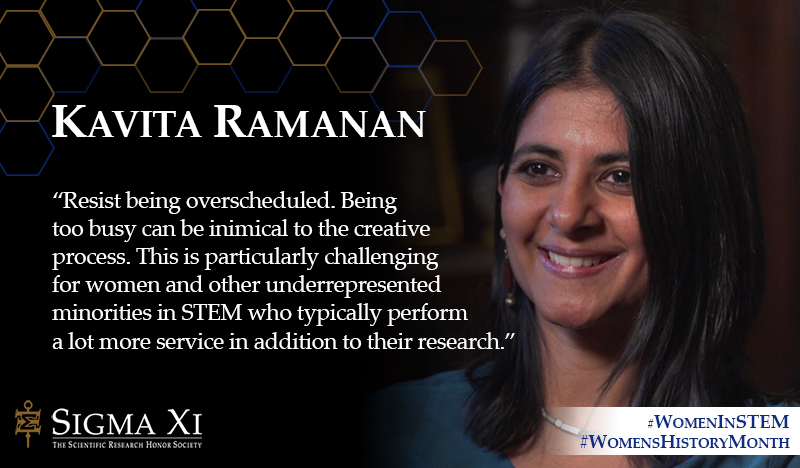
    kavita_ramanan_web_graphic_800

    Kavita Ramanan

    Roland George Dwight Richardson University Professor of Applied Math at Brown University

    How are you breaking barriers faced by women in your field?

    When I joined the Division of Applied Math at Brown University in 2010, I was the only woman on the faculty and I was surprised to learn that I was the first tenured woman in almost two decades. I found the faculty welcoming, but nevertheless felt it was important to have more diverse representation at all levels of seniority. With this in mind, I have tried to contribute in a small way through various initiatives through the years. In 2013 I co-founded (with graduate student A. Howard) the Association for Women in Mathematics student chapter at Brown. The next year I founded the Math Co-Op, a math outreach group whose aim is to promote math, especially to minorities and socio-economically disadvantaged students. In 2017 we held the WINRS (Women's Intellectual Networking Research Symposium) at Brown to promote intellectual exchange between researchers in the New England area. Currently, I am co-organizing "Mathematics sin Fronteras," a bilingual math outreach lecture series for undergraduate students that features four leading bilingual women lecturers.

    Who is another woman in STEM you admire and why? 

                   
    I am afraid I cannot just name one, and must seize this opportunity to highlight some remarkable women in STEM I have had the incredible good fortune to interact with professionally.

    Four women in my field (probability theory) whom I find inspirational are Ruth J. Williams, Distinguished Professor at the Mathematics Department at UCSD, for the pristine quality of her mathematical exposition, her wisdom and her modest demeanor despite an illustrious career; Jennifer Chayes, Associate Provost of Computing, Data Science, and Society and professor in four UC  Berkeley Departments, as well as formerly managing director at Microsoft Research, where she co-founded and led three interdisciplinary labs, for her exuberance and remarkable ability to wear so many managerial hats while still doing incredible research; Alison Etheridge, OBE FRS, Professor of Probability, Head of the Department of Statistics, University of Oxford, for her influential contributions to mathematical population genetics and generosity of spirit; and Haya Kaspi, Professor emeritus, Technion, Israel, for her infectious love of the subject and undying sense of humor, even in the face of adversity. 

    Another mathematician that I also greatly admire is Jill Pipher, Elisha Benjamin Andrews Professor of Mathematics at  Brown University, for her unbelievable ability to juggle multiple high-profile administrative positions in addition to her research, while always retaining a genuine human touch. 

    I must also mention two other women in STEM whom I have never met but whose stories I find uplifting. The first is Evelyn Boyd Granvillle, who was the second African American woman to earn a PhD in the U.S. for her pioneering contributions to NASA space programs, as a research scientist at IBM, and her lifelong commitment to disseminating mathematics. The second is geneticist Marie-Claire King, who has done pathbreaking research in genetics, often using analytical (and mathematical) insights to forge new discoveries that upended the conventional wisdom in her field at the time. In addition, I was truly inspired by her dedication to human rights advocacy throughout her life and her remarkable success in integrating that into her work (e.g., by developing and applying dental genomic sequencing to identify victims of human rights abuse who went missing, and uniting them with their families).

    What is one piece of advice you have received from a colleague or mentor that stuck with you and/or made an impact?

    High-quality research requires a constant delicate balance between gaining technical expertise in a narrowly focused area and developing broad scholarship with an interdisciplinary outlook.  Another piece of advice that I constantly repeat to myself is that being too busy (an unfortunate, seemingly inexorable, trend in current-day academia), can be inimical to the creative process.  Resisting being overscheduled is particularly challenging for women and other underrepresented minorities in STEM who typically perform a lot more service in addition to their research.

    • About

      • Support Sigma Xi
      • Organization
      • Leadership
      • History
      • Sigma Xi Merchandise
      • Jobs
      • FAQ
      • Contact Us
    • Programs

      • Ethics and Research
      • Grants-in-Aid
      • Critical Issues in Science
      • Lectureships
      • Prizes & Awards
      • Partnerships
      • Science Cafes
      • Globally Engaged Workforce
      • Affiliate Circle
    • Chapters

      • Locate a Chapter
      • Chapter Awards
      • Chapter Program Models
      • Officer Resource Center
    • Meetings & Events

      • International Forum on Research Excellence (IFoRE)
      • Student Research Showcase
      • Past Events
      • Volunteer
    • Members

      • Join / Nominate
      • Renew
      • Benefits
      • MembersOnly
    • News

      • Sigma Xi Today
      • Keyed In Blog
      • News Archive
      • Meet Your Fellow Companions
      • Newsletters
      • Members in the News

      Publications

      • American Scientist
      • Chronicle of The New Researcher
    Sigma Xi, The Scientific Research Honor Society

    For USPS mailings: P.O. Box 13975, Research Triangle Park, NC 27709
    For packages & in-person visits: 700 Park Offices Drive, Suite 160, Research Triangle Park, NC 27713

    • Phone: 800-243-6534 or 919-549-4691
    • Fax: 919-549-0090
    • Privacy Policy
    • Refund Policy
    • Terms and Conditions
    • State Fundraising Notices
    • Copyright ©2025. All Rights Reserved.